How to manage leads: a simple pipeline, faster replies and fewer lost quotes
Muskaan Sharma·Updated 3 Nov 2026·13 min read

Get every enquiry into one list the day it arrives, reply within a target you can keep (an hour or two in opening hours), and ask two to four questions to check fit. Give every open lead a next step with a date, follow up quotes on a set schedule, and close each lead as won or lost with a one-word reason. Five stages are enough: New, In conversation, Quoted, Won, Lost. Review the list weekly, starting with leads that have waited longest.
A lead is anyone who has put their hand up but hasn't bought yet: the person who filled in your quote form, the bride asking about your June availability, the office manager who wants a cleaning price. Managing leads is everything between that first message and a clear yes or no.
When I look at how small businesses lose work, it's rarely because they're bad at selling. It's because an enquiry sat in an inbox over the weekend, a quote was never chased, or two people each thought the other was handling it. The fixes are unglamorous, cheap and mostly about habits, which is good news, because habits are free.
I'm a user researcher at KahuLogic, where we build websites and marketing tools for small businesses. I'll mention our own tool once, near the end; everything else works whichever tools you use.
What does lead management actually mean?
Lead management is the process of capturing every enquiry in one place, replying quickly, working out whether it's a good fit, agreeing a next step, and recording the outcome as won or lost. It's a simple line that every lead moves along, and your job is to make sure nobody gets stuck on it.
The line is the same whether you use a CRM, a whiteboard or a spreadsheet. The tool matters less than two rules: every lead is in one list, and every open lead has a next step with a date.
Why does reply speed matter so much?
Because people asking for a quote are usually asking several businesses at once, and the first good answer often wins. The best-known evidence is a 2011 Harvard Business Review study by James Oldroyd, Kristina McElheran and David Elkington. They sent test enquiries through the websites of 2,241 US companies. Only 37% replied within an hour, 23% never replied, and among those that replied within 30 days the average wait was 42 hours.
The same article reported an analysis of 1.25 million leads, which found firms that tried to make contact within an hour were nearly seven times as likely to qualify the lead as those that waited even an hour longer. The data is old and mostly from larger companies, so I wouldn't treat the multiplier as a rule for a two-person plumbing business. But the direction matches what most owners already feel: the enquiry that waits overnight is often gone by morning.
You don't need to answer in five minutes around the clock. You need a target you can keep. For most small businesses I'd suggest a first human reply within two working hours, and an honest acknowledgement straight away if you can't manage that, saying when someone will be in touch.
Five habits that keep leads moving
- 1One list, no exceptionsEvery enquiry from the website, email, social messages and phone goes into the same list the day it arrives. A lead that only lives in one person’s phone is invisible to everyone else.
- 2A reply target you keepPick a first-reply target for opening hours, such as two hours, and check yourself against it every week.
- 3Qualify in a few questionsWhat do they need, where, by when, and roughly what budget? Two to four questions, asked naturally, tell you whether to quote, book a visit or politely decline.
- 4Always a next step and a date“Send quote Friday”, “Call back Tuesday 10am”, “Site visit 14th”. If a lead has no next step, it isn’t being managed.
- 5Close it, with a reasonMark every lead won or lost. A one-word lost reason (price, timing, went elsewhere, no reply, not a fit) is some of the most useful data you will ever collect.
Pipeline stages that make sense for a small business
You don't need ten stages. Five is enough for most service businesses, and each stage should tell you exactly what to do next.
| Stage | What it means | Your next move | How long is too long? |
|---|---|---|---|
| New | Enquiry received, not yet answered | Reply | More than your reply target |
| In conversation | You’re answering questions or arranging a visit | Qualify and propose a next step | A week with no next step |
| Quoted | Price or proposal sent | Follow up on a set date | No contact for 3 to 5 working days |
| Won | They said yes | Hand over to booking or delivery | Same day |
| Lost | They said no, or went silent after your follow-ups | Record the reason | Close it rather than leave it open |
The last column matters most. A stage only helps if you know when a lead has been in it too long. Once a week, sort your list by how long each lead has sat in its stage and deal with the oldest first.
How to qualify a lead without interrogating them
Qualifying just means checking whether you can help, and whether it's worth both your time to continue. The worst version is a long form with twelve required fields. The best version is two or three friendly questions in your first reply.
- What exactly do you need? (A bathroom refit, a weekly office clean, wedding photos for 80 guests.)
- Where? Useful for anyone who travels, and a polite way to catch enquiries outside your area.
- When? A date or a rough timeframe tells you how urgent it is and whether you're available.
- Roughly what budget, or what have you seen elsewhere? Ask gently; many people don't know, and that's useful too.
If the answers show it's not a fit, say so kindly and quickly, and if you can, point them somewhere better. A fast, honest “we're not the right people for this” builds more goodwill than a slow quote you never expected to win.
How to follow up a quote without being pushy
Most quotes that go quiet aren't rejections. The person got busy, is waiting on a partner, or is comparing three prices and hasn't decided. A short, useful follow-up on a set date is part of good service.
- Day 0: send the quote with a clear summary, what's included, how long it's valid and how to say yes.
- Day 3 to 5: a short check-in. “Did the quote make sense? Happy to adjust the scope if the budget's tight.”
- Day 10 to 14: one last note. “I'll close this off for now. If you'd like to go ahead later, just reply and we'll check dates.”
- Then mark it lost with the reason “no reply” and stop.
On consent: in New Zealand, the Unsolicited Electronic Messages Act's definition of a commercial electronic message excludes a quote or estimate the recipient asked for, so sending a requested quote and following up on it is different from marketing. If you later want to add that person to promotions or a newsletter, that needs consent, a clear sender and an unsubscribe, under the guidance from New Zealand's Department of Internal Affairs and Australia's ACMA. Keep the two separate.
Copy these: six messages for every stage
Most owners know they should reply fast and follow up. What slows them down is writing the message from scratch every time. Here are the six I'd keep saved as templates or quick replies. Change the words in square brackets, and rewrite anything that doesn't sound like you.
- 11. First reply, when you can answer nowHi [name], thanks for getting in touch about [job]. Happy to help. So I can give you an accurate price, could you tell me: [question 1, e.g. roughly how big the space is], [question 2, e.g. where you're based] and [question 3, e.g. when you'd like it done]? Once I have those I'll send a quote by [day]. [Your name], [business]
- 22. Holding reply, when you can't answer properly yetHi [name], thanks for your message about [job]. I'm on a job until [time], so I'll reply properly by [time/day]. If it's urgent, call me on [number]. [Your name]
- 33. Not a fit, said kindlyHi [name], thanks for thinking of us. [Job] isn't something we do well, and I'd rather tell you now than send a quote that wastes your time. [If you can: You might try a specialist in (type of business).] Good luck with it. [Your name]
- 44. The quoteHi [name], here's your quote for [job]: [price], including [what's included], valid until [date]. Not included: [anything they might assume]. To go ahead, just reply 'yes' and I'll book you in for [first available date]. Any questions, I'm happy to talk it through. [Your name]
- 55. Follow-up, 3 to 5 working days laterHi [name], just checking the quote for [job] made sense. If the budget's tight, I'm happy to look at [a smaller option / a different start date]. Either way, let me know and I'll keep your dates free until [day]. [Your name]
- 66. Closing the loop, 10 to 14 days laterHi [name], I'll close this quote off for now so I'm not filling your inbox. If you'd like to go ahead later, just reply to this message and I'll check dates for you. Thanks again for asking us. [Your name]
Two small things make these work. Every message ends with one clear next step, so the customer never has to work out what to do. And message 6 often gets a reply of its own: a polite close-off gives people permission to say “sorry, we went with someone else”, which is exactly the lost reason you want to record.
A lead list you can set up in ten minutes
If you're not ready for a CRM, a shared spreadsheet works, as long as everyone uses the same columns. These are the ten I'd start with. The example row is made up.
| Column | What goes in it | Example (made up) |
|---|---|---|
| Date in | The day the enquiry arrived | 4 Nov |
| Name and contact | Name, plus the email or number they used | Sam, sam@example.com |
| Source | Where it came from: website form, email, phone, Facebook, referral | Website form |
| Need | The job, in a few words | Weekly office clean, 3 rooms |
| Stage | New, In conversation, Quoted, Won or Lost | Quoted |
| Next step | The very next action | Follow-up message 5 |
| Next step date | When it's due. Sort by this column every morning | 8 Nov |
| Owner | Who on the team is handling it | Priya |
| Value | The quote amount, or your best guess | NZ$180 a week |
| Lost reason | One word, only when the stage is Lost | Price, timing, went elsewhere, no reply, not a fit |
The column that does the work is “Next step date”. Sort by it every morning and you have your to-do list. Filter Stage to Quoted and sort by Date in, and you can see in seconds which quotes nobody has chased.
A worked example: a cleaning company fixes its leaks
Here's a worked example. The business and every number in it are made up, so swap in your own. Say a commercial cleaning company gets 40 enquiries a month. It quotes 25 of them and wins 6, so its quote-to-win rate is 24%. The owner assumes the problem is price.
Then she adds a lost reason to every closed lead for two months. Of the 19 quotes lost each month, the reasons come back roughly as: 9 no reply, 5 went elsewhere, 3 price, 2 timing. Price, it turns out, is the smallest problem. “No reply” is the biggest, and nobody had been following those quotes up at all.
She adds the follow-up messages above. Say a third of the 9 “no reply” quotes now answer (3 people), and a third of those go ahead: that's 1 extra contract a month. At a made-up NZ$600 a month per contract, each one is worth NZ$7,200 over a year. Win one extra contract a month for six months and, by the end of that time, the business is billing an extra NZ$3,600 a month, for the cost of two short messages per quote. None of it required cutting prices, which is what she was about to do. That's why I care so much about lost reasons: they stop you fixing the wrong thing.
What to measure each week
Five numbers are enough. Write them down every Friday in a notebook if you like; the habit matters more than the tool.
- New leads this week, and where they came from.
- Median time to first reply. Median rather than average, so one weekend enquiry doesn't hide everything else.
- Open leads with no next step. The target is zero.
- Quotes older than five working days with no follow-up.
- Won and lost this week, with lost reasons.
Do you need a CRM to manage leads?
Not for a handful a month. Once leads arrive in several places, or more than one person replies, a CRM stops enquiries falling through the gaps, mainly by capturing website forms automatically and putting dates on next steps. Starting costs are lower than many owners think. HubSpot's free CRM covers up to two users and 1,000 contacts. Zoho CRM's free edition covers up to three users. Pipedrive, built around a visual pipeline, lists its Lite plan at US$14 per seat a month billed annually.
Whatever you choose, the time saving is real. Salesforce's 2026 State of Sales report, a vendor survey, found sellers spend only about 40% of their time actually selling. For a small business owner, every minute not spent copying enquiries between apps is a minute for the work itself.
If you only do three things this week
- Put every open enquiry from the last month into one list, with a stage and a next step date for each.
- Save messages 1, 5 and 6 above as templates or quick replies on the phone you use for work.
- Go through every quote older than five working days, send message 5 or 6, and mark the ones that are already lost with a reason.
Where Kahu fits
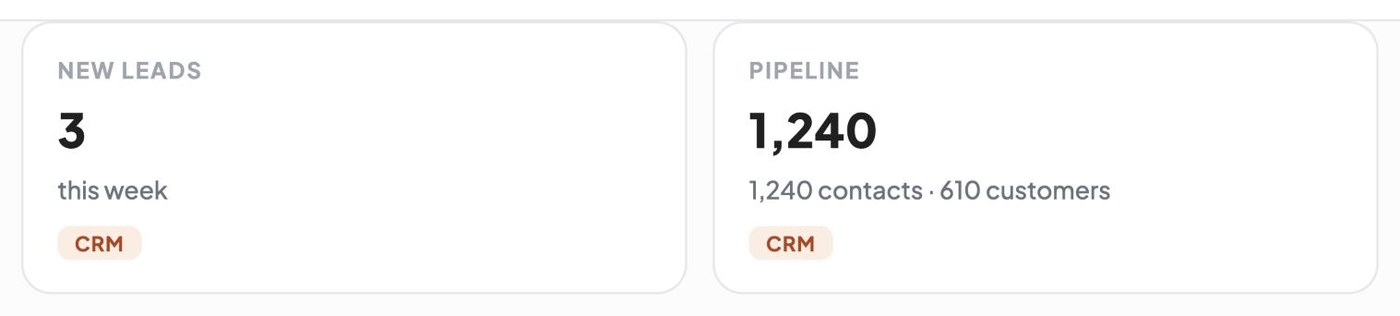
If you'd like help without handing over the keys, here's what our tools do. In Kahu CRM, website and form enquiries arrive as contacts tagged with their source, so you can see which channel each lead came from, and Kahu drafts the follow-up for you to check and send. Work Kahu drafts waits in your approvals queue until you approve it, and automations run only when you switch them on. Your website, ads and CRM are included from Growth (US$179 a month, or US$149 billed yearly). Starter (US$69) covers social posting, Creative Studio and chat. Starter, Growth and Pro start with a 14-day free trial.
 Where Kahu fits


 Website form · asked for a valuation · 2h ago
 Email · quiet 6 days
I'm Muskaan Sharma, User Researcher at KahuLogic, a New Zealand company with a team across Australia, New Zealand and India. My honest view is that most small businesses already get enough enquiries; what they need is a list they trust and the discipline to give every open lead a next step.
Frequently asked questions
How do you manage leads in a small business?
Put every enquiry into one list, reply within a target you can keep, ask two to four questions to check fit, give every open lead a next step with a date, and close each one as won or lost with a short reason. Review the list once a week.
How fast should I respond to a new lead?
As fast as you reliably can during opening hours, ideally within an hour or two. A 2011 Harvard Business Review study found firms that tried to make contact within an hour were nearly seven times as likely to qualify a lead as those that waited longer, though the data is old and mostly from larger companies.
What stages should a sales pipeline have?
Five is enough for most small businesses: New, In conversation, Quoted, Won and Lost. Each stage should have a clear next action and a limit on how long a lead can sit there before someone acts.
How many times should I follow up on a quote?
Two or three times is usually enough: a check-in three to five working days after the quote, a final note around ten to fourteen days, then mark it lost with the reason “no reply”. Keep each message short and helpful.
When should I mark a lead as lost?
When they say no, or when they haven’t replied after your planned follow-ups. Closing it keeps the pipeline honest, and the lost reason tells you whether price, timing or follow-up is the real problem.
What is the difference between a lead and a customer?
A lead has shown interest but hasn’t bought. A customer has bought or booked. Once a lead is won, they become a customer, and the focus shifts from winning a yes to earning the next booking.
Sources, checked 3 November 2026
- Harvard Business Review: The short life of online sales leads (2011)hbr.org
- Salesforce: State of Sales report announcement (vendor survey, 2026)salesforce.com
- HubSpot: free CRM software for small businesseshubspot.com
- Zoho: Zoho CRM pricing and editionszoho.com
- Pipedrive: CRM pricing planspipedrive.com
- NZ Legislation: Unsolicited Electronic Messages Act 2007, section 6legislation.govt.nz
- Department of Internal Affairs: NZ spam law for businessesdia.govt.nz
- ACMA: avoid sending spamacma.gov.au