What is an AI customer service agent? How it works and where it should stop
Muskaan Sharma·Updated 3 Nov 2026·13 min read

An AI customer service agent is software that reads a customer's message, works out what they want and replies in plain language using your business's own information. Unlike a scripted chatbot with buttons, it copes with questions phrased any way, and if it's connected to your systems it can take simple actions such as checking availability. It runs on a large language model, so it needs firm limits: answer only from your information, say when it doesn't know, never make promises outside your policies, and hand over to a person quickly. Your business is responsible for what it says.
“AI agent” has become one of those phrases that's everywhere and means something slightly different every time. Vendors use it for anything from a website chat bubble to software that can cancel subscriptions and issue refunds on its own. If you run a small business and someone's trying to sell you one, it's fair to ask: what is it, actually, and what will it do with my customers?
I'm a user researcher at KahuLogic, where we build websites and marketing tools for small businesses. I'll mention our own tool once, near the end; everything else works whichever tools you use.
An AI customer service agent, in plain English
Think of it as a new team member who has read everything you've written down about your business and never sleeps. A customer asks, “Can you fit me in Saturday morning for a full colour?” The agent understands the question even though it doesn't match any script, checks what it's allowed to check, and replies. If the customer is upset or wants something only you can decide, it passes the conversation to a person with a short summary.
Under the hood, it runs on a large language model, the same kind of AI behind tools like ChatGPT and Claude. What turns a general AI model into a customer service agent is what it's connected to: your information, the systems it's allowed to use, and a set of rules about what it may do and when to stop.
Chatbot, workflow or agent: what's the difference?
Anthropic, the company behind Claude, draws a useful line in its guide Building effective agents. It calls workflows systems where AI models and tools follow predefined code paths, and agents systems where the model directs its own process and decides which tools to use. In customer service terms, that gives three rough types.
| Scripted chatbot | AI workflow | AI agent | |
|---|---|---|---|
| How it decides | Fixed buttons and keyword rules | AI writes the words, but the steps are set in advance | AI chooses the steps, within limits you set |
| Copes with odd phrasing | Poorly | Well | Well |
| Can take actions | Only the ones scripted | Only at fixed points in the flow | Can choose among the tools you've connected |
| Predictability | High | High | Lower: needs tighter rules and review |
| Good small-business fit | Very simple menus | Most customer questions | Narrow, well-defined tasks with clear limits |
Anthropic's own advice is to favour the simplest option that works, and to add agent-style autonomy only when a task genuinely needs it. I'd say the same to a small business. Most of your customer questions, such as hours, prices, availability and policies, are better served by an AI that answers from your information in a predictable way than by one that improvises.
How it answers a question, step by step
The crucial step is the lookup. A well-built agent searches the information you've given it, such as your website pages, help articles, price list and policies, and writes its answer from what it finds. A badly built one leans on the model's general knowledge and fills gaps with guesses. Ask any vendor how theirs grounds its answers, and what it does when your information doesn't cover the question.
What it's connected to
- Knowledge: your website, help articles, price list, policies and frequently asked questions.
- Channels: where it talks to customers, such as website chat, email, WhatsApp or social messages.
- Tools: systems it may read or change, such as a booking calendar or an order lookup.
- Rules: what it must never do, which topics go to a person, and how it introduces itself.
- People: who it hands over to, at what times, and what context it passes on.
The more tools an agent can use, the more useful it is and the more careful you need to be. Reading availability is low risk. Moving or cancelling a booking, issuing a refund or changing an order is higher risk, because a misunderstanding becomes an action rather than a sentence.
A worked example: a florist's agent on a busy Friday
Here's a worked example. The business and every detail in it are made up, so swap in your own. Picture a florist with a website chat agent connected to its website pages and price list, but not to its order system.
At 9:40 pm a customer asks, “Do you deliver to the hospital on Saturdays and how much for a medium bouquet?” The agent finds the delivery page, which says Saturday deliveries run until noon to local addresses including the hospital, and the price list, which says medium bouquets start at a set price plus a delivery fee. It replies with both, links the order page and says it's the florist's AI assistant.
Then the customer asks, “Can you change my order from last week to lilies?” The agent can't see orders and the florist's rules say order changes go to a person. So it says a team member will reply when the shop opens at 8 am, and passes on the customer's details and request. That's an agent doing its job well: fast where it has the facts, and honest about where it stops.
Now the sums, which are made up too. Say the florist's chat gets 60 questions a month, and the agent answers 45 of them from the website, passing 15 to a person. If each of those 45 would have taken the owner 3 minutes to answer, that's 45 × 3 = 135 minutes, a little over 2 hours a month. And say 20 of the 45 arrive after closing, and 4 of those people order that night instead of trying another florist. At a made-up NZ$90 average order, that's 4 × NZ$90 = NZ$360 a month, or NZ$4,320 a year. Set those two numbers against the tool's monthly fee and the 15 minutes a week you spend reading its conversations, and you know whether it's earning its place.
What it should and shouldn't do on its own
| Generally safe to let it do | Keep with a person |
|---|---|
| Answer questions from your written information | Anything not covered by your information |
| Point to your booking or order page | Moving, cancelling or changing bookings and orders, unless your system has firm rules |
| Collect details for a quote | Giving a price outside your published list |
| Explain a policy as written | Agreeing to an exception, refund or discount |
| Summarise the conversation for your team | Complaints and anything emotional, medical, legal or financial |
Who's responsible when it gets something wrong?
You are. The clearest example is Moffatt v Air Canada, decided by British Columbia's Civil Resolution Tribunal in February 2024. Air Canada's website chatbot told a customer he could claim a bereavement fare after travelling, which wasn't the airline's policy. Air Canada argued the chatbot was a separate entity responsible for its own actions. The tribunal rejected that, saying the chatbot was still just part of Air Canada's website, and ordered the airline to pay the difference.
It's a small-claims tribunal in Canada, not binding in Australia or New Zealand, but the logic is hard to argue with. Whatever your agent tells a customer, your business told them. That's the real reason to keep agents grounded in your information and to limit what they can promise.
Be open that it's AI, and protect customer data
Tell customers they're talking to an AI agent. Salesforce's research found 72% of customers say it's important to know. If you serve customers in the European Union, the EU AI Act's Article 50 requires that people be informed when they're interacting with an AI system; law firm Baker Botts describes those transparency duties as applying from 2 August 2026. Gartner's survey also found 60% of customers worry AI will make it harder to reach a person, so make the route to a human obvious.
On privacy, Australia's OAIC published guidance in October 2024 on using commercially available AI products, recommending due diligence before you choose one and care with personal information. New Zealand's Privacy Commissioner says the Privacy Act's Information Privacy Principles apply to AI tools too. Ask any vendor where conversations are stored, who can see them and whether they're used to train models.
How to start one safely
- 1Write the sourceServices, published prices, hours, policies and your most common questions with real answers, on your website or in one document.
- 2Start with drafts or a narrow jobLet it draft replies a person approves, or answer only website questions from your pages.
- 3Set clear limitsList what it must never do: offer discounts, promise dates, change bookings, handle complaints.
- 4Test the handoverPlay an upset customer. You should reach a person in one step, with the conversation passed on.
- 5Review weeklyRead a sample of conversations. Every wrong answer is a missing fact or a missing rule.
- 6Widen slowlyGive it more freedom only for kinds of question it has handled correctly for weeks.
Copy these: six rules to give an AI customer service agent
Most tools have a box for instructions, whether they call it a system prompt, a persona, guidance or rules. Whatever is in that box decides how the agent behaves when your information runs out. These are the six rules I'd paste in first. Change the parts in square brackets, and keep each rule as one short paragraph so it's easy to find and fix later.
- 11. Who it is and how it introduces itselfYou are the AI assistant for [business], a [type of business] in [town or area]. Start every new conversation with: “Hi, I'm [business]'s AI assistant. I can help with [services, prices, hours and bookings]. If you'd like a person at any point, just say so.” Write in a [three words, e.g. warm, plain, brief] tone, use [NZ/Australian/British] spelling, and keep replies to three sentences or fewer unless the customer asks for more.
- 22. Answer only from our informationAnswer only from these sources: [list them, e.g. our website pages, the price list dated (date), the policies document]. If the answer isn't in them, don't guess and don't use general knowledge. Say: “I'm not sure about that, so I'll pass it to the team. Someone will reply by [time or 'the next working morning'].”
- 33. Things you must never doNever: offer a discount, refund or freebie; agree to an exception to any policy; promise a date, time or price that isn't in [source]; give medical, legal or financial advice; ask for card numbers or passwords; change, move or cancel a booking or order; or talk about other businesses. If a customer asks for any of these, hand over using rule 4.
- 44. When to hand over to a personHand the conversation to a person straight away if the customer asks for one, is upset or complaining, mentions [refund, damage, injury, allergy or anything about safety], or asks the same thing twice. Say: “I'll pass this to [the team / name] now. They usually reply within [time], and they'll see everything you've told me, so you won't need to repeat it.”
- 55. The handover noteWhen you hand over, write a note for the team in exactly this format. Customer: [name and how to contact them]. Wants: [one sentence]. Already told them: [what you said]. Still open: [the question you couldn't answer]. Mood: [calm / unhappy / urgent].
- 66. Outside opening hoursOur opening hours are [e.g. 8 am to 5 pm, Monday to Friday]. Outside them, say: “The team's away until [next opening time]. I can answer questions about [topics] now, or take your details and someone will get back to you then.” Never say a person will reply sooner than that.
Then test the rules before a customer does. Play three customers: one with an easy question, one whose question your information doesn't cover, and one who is annoyed about a late order. If the agent breaks a rule, the rule is usually too vague, so tighten its wording rather than adding a seventh. Keep the six rules in one document with the date you last changed them, and update rule 2's sources every time your prices or hours change.
Questions to ask before you buy one
- Where does it get its answers, and what does it do when my information doesn't cover a question?
- Which actions can it take on its own, and can I switch each one off?
- How does it hand over to a person, and what does the person see?
- Does it tell customers it's an AI?
- Where are conversations stored, and are they used to train models?
- How am I charged: per conversation, per resolution or per seat?
If you only do three things this week
- Write down your 20 most common customer questions with real answers, current prices and hours, in one document or on your website.
- Fill in the six rules above for your business, including the exact words the agent uses to hand over to a person.
- If you already use a chat or AI tool, test it as three customers (simple, not covered, upset) and write down every answer that breaks a rule.
Where Kahu fits
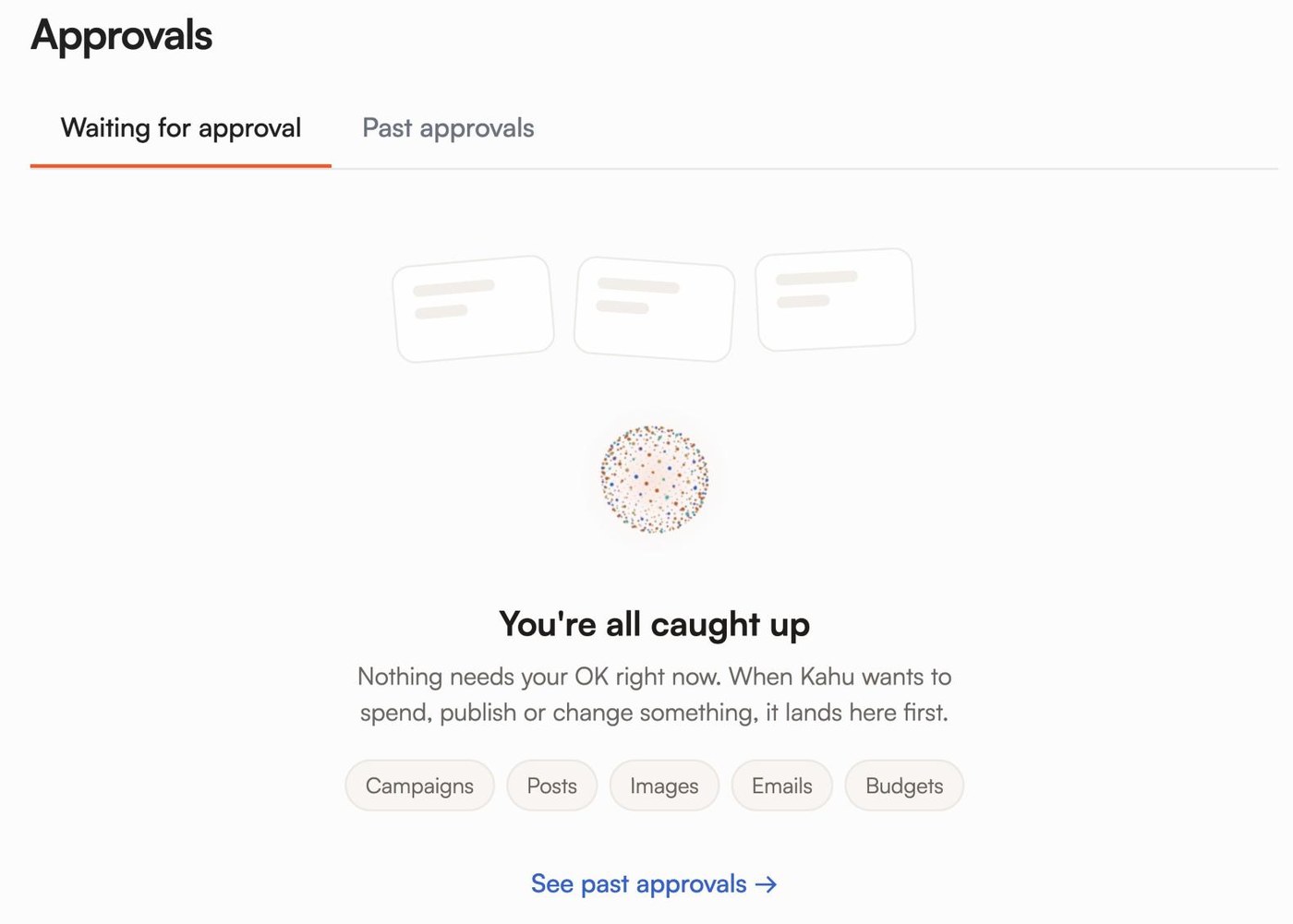
If you'd like help without handing over the keys, here's what our tools do. Kahu Assist is website chat that answers visitors' questions from your site's own pages and can hold a booking slot, but never changes a booking. WhatsApp Inbox is live on every plan: Kahu drafts each reply from your prices and hours, and a person on your team taps send. Work Kahu drafts waits in your approvals queue until you approve it, and automations run only when you switch them on. Your website, ads and CRM are included from Growth (US$179 a month, or US$149 billed yearly). Starter (US$69) covers social posting, Creative Studio and chat. Starter, Growth and Pro start with a 14-day free trial.
 Where Kahu fits

 Two Thursday gaps at 11:00 and 14:30. Drafted texts to 6 regulars who asked about Thursdays.
 New hours drafted for your site: Sat and Sun, 8am to 2pm.
 One post about the new hours, using your Sunday counter photo.
I'm Muskaan Sharma, User Researcher at KahuLogic, a New Zealand company with a team across Australia, New Zealand and India. My honest view is that the best AI customer service agent for a small business is a modest one: it knows your information well, it's open about being AI, and it knows exactly where its job ends.
Frequently asked questions
What is an AI customer service agent?
Software that reads customer messages, understands what people want and replies in plain language using your business's information. It runs on a large language model and, if connected to your systems, can take simple actions such as checking availability. It should hand over to a person for anything it can't answer well.
Is an AI agent the same as a chatbot?
Not quite. A scripted chatbot follows fixed buttons and rules. An AI agent understands free-form questions and can decide which connected tools to use within limits you set. Many products sit in between, using AI to write replies while following fixed steps.
Who is responsible if an AI agent gives wrong information?
The business. In Moffatt v Air Canada in 2024, a Canadian tribunal rejected the airline's argument that its chatbot was responsible for its own words and ordered it to compensate the customer. Keep your agent limited to your written information and policies.
Do I have to tell customers they're talking to AI?
It's good practice everywhere, and for customers in the EU the AI Act's Article 50 requires that people be informed when they interact with an AI system. Salesforce's research found 72% of customers say it's important to know.
Can an AI agent work on WhatsApp and email?
Many can, depending on the product, usually through the WhatsApp Business Platform for WhatsApp. Check which channels a tool supports and whether it replies on its own or drafts for a person to send.
Will AI agents replace customer service staff?
Gartner predicts agentic AI will resolve 80% of common customer service issues without a person by 2029, but that's a forecast, not a guarantee. For a small business, an agent usually takes repeat questions and leaves people for complaints, exceptions and relationships.
Sources, checked 3 November 2026
- Anthropic: Building effective agentsanthropic.com
- Gartner: predicts agentic AI will autonomously resolve 80% of common customer service issues by 2029gartner.com
- Gartner: survey finds 64% of customers would prefer companies didn't use AI for customer servicegartner.com
- Salesforce: State of the AI Connected Customersalesforce.com
- American Bar Association: BC tribunal confirms companies remain liable for information provided by AI chatbotamericanbar.org
- Baker Botts: EU AI Act Article 50 transparency obligations go livebakerbotts.com
- OAIC: guidance on privacy and the use of commercially available AI productsoaic.gov.au
- NZ Privacy Commissioner: AI tools and the Privacy Actprivacy.org.nz