How much do Facebook ads cost? Budgets, cost per click and cost per lead for a small business
Muskaan Sharma·Updated 3 Nov 2026·14 min read
Facebook ads have no set price. You choose a budget, as little as a few dollars a day, and Meta's auction decides how many people see your ad and what each result costs. WordStream by LocaliQ's 2026 benchmarks put the average click on a traffic campaign at US$0.60 and the average lead at US$27.39, but a cheap lead isn't always a cheap customer. Work your budget backwards from what a customer is worth, give a campaign about 50 results a week to learn from, and judge it on bookings and sales, not clicks or form fills.
Facebook and Instagram ads look cheap next to Google. A click can cost well under a dollar, and a lead form can fill up in a day. Then the calls start and half the “leads” don't remember filling anything in. This guide explains what sets the price of a Facebook ad, what businesses typically pay according to published benchmarks, and how to work out a budget, with five ad copy formulas to copy at the end.
I'm a user researcher at KahuLogic, where we build websites and marketing tools for small businesses. I'll mention our own tool once, near the end; everything else works in any Meta ads account. When I say Facebook ads, I mean ads bought in Meta Ads Manager, which can run on Facebook, Instagram, Messenger and Meta's partner apps from one campaign.
The first two figures come from WordStream by LocaliQ's 2026 Facebook ads benchmarks, drawn from US campaigns it manages, as reported by Search Engine Land. Traffic clicks got cheaper, while the average cost per lead barely moved. Use them for a sense of scale, not as a forecast: a dog groomer in a small town and a solar installer in a capital city will be miles apart.
How Meta decides what you pay
Every time there's a space for an ad in someone's feed, Stories or Reels, Meta runs an auction among the advertisers who want to reach that person. Unlike a Google search, nobody has asked for anything yet. Meta is guessing who is likely to respond to which ad.
Meta's help pages describe the winner as the ad with the highest total value, which combines three things: your bid (set by you, or by Meta's automatic bidding within your budget), the estimated chance that this person takes the action you've asked for, and the ad's quality, judged partly from how people react to it. That last part matters for a small advertiser. An ad people hide or report costs more to show, and an ad that people stop and engage with can beat a bigger budget.
Most campaigns are charged for impressions, the number of times your ad is shown, and the cost per click or per lead you see in reports is the result of that. So the levers that bring your costs down are the same ones that make an ad good: the right audience, a clear offer, and creative that suits the placement.
What makes Facebook ads cheap or expensive
- Who you're trying to reach. A small, tightly defined audience that many advertisers want (homeowners in one suburb, say) costs more per view than a broad one.
- The time of year. Costs usually climb in the weeks before big shopping and holiday periods, when large retailers bid for the same feeds.
- What you ask Meta to find. Asking for clicks finds people who click. Asking for leads finds people who fill in forms. Asking for purchases or bookings finds people who buy, and each result costs more because there are fewer of them.
- Your creative. A thumb-stopping video or a clear photo of the result usually costs less per click than a stock image with a block of text.
- Your offer. “Book a free 15-minute quote” gets more response than “Contact us today”, and more response lowers what each result costs.
- Placements. Letting Meta choose placements across Facebook, Instagram and Reels usually finds cheaper views than forcing one placement.
Here's how far apart campaign types are, from the same LocaliQ benchmarks. Treat it as a feel for the range.
| Campaign type (WordStream by LocaliQ, 2026) | What you're paying for | Typical figure |
|---|---|---|
| Traffic campaigns | People clicking to your website | US$0.60 a click, 1.93% of viewers clicking |
| Lead campaigns | People filling in a form | US$27.39 a lead, US$1.80 a click |
| Your own campaign | Customers who book or buy | Only your own tracking can tell you |
Work your budget backwards from a customer
As with Google Ads, the number that matters is the most you'd pay to win one new customer. Here's a worked example. The business and every number in it are made up, so swap in your own. Imagine a home cleaning business whose first clean is worth US$160, and whose regular customers book about six cleans a year. After costs, the owner is happy to spend up to US$120 to win a new regular.
They try two ways of using the same US$600 a month: a traffic campaign that sends people to a booking page on their website, and a lead campaign with a Meta instant form.
| Worked example (made-up numbers) | Website campaign | Instant form campaign |
|---|---|---|
| Monthly budget | US$600 | US$600 |
| Cost per click or per lead | US$0.80 a click | US$15 a lead |
| Clicks or leads | 750 clicks | 40 leads |
| Enquiries | 23 (3% of clicks booked a quote) | 40 form fills |
| Enquiries that became customers | 35%, about 8 | 10%, about 4 |
| Cost per new customer | About US$75 | About US$150 |
On the dashboard, the form campaign looks like the winner: 40 leads instead of 23 enquiries. Counted in customers, it's twice as expensive and over the owner's US$120 limit. That pattern is common. Instant forms are quick to fill in on a phone, which is exactly why some people fill them in without much thought. Meta offers a “higher intent” form type that adds a review step before someone submits, which reduces volume and usually improves quality. Whichever you use, call or message every lead fast, and count what happens.
Run it for a year and the gap is plain. US$7,200 of spend brings about 96 new regulars through the website campaign (8 × 12) against about 48 through the form (4 × 12). If a regular is worth a made-up US$960 a year (six cleans at US$160), that's about US$92,000 of first-year bookings against about US$46,000, from the same budget.
Setting a daily budget
Meta asks for a daily budget or a total (lifetime) budget for a campaign. Meta's help pages explain how a daily budget is used: on days with better opportunities, Meta may spend up to 75% more than your daily budget, but over a week it won't spend more than seven times your daily amount. So a US$20 daily budget can spend US$35 on a good Tuesday, and no more than US$140 across the week.
Budget enough for the campaign to learn. Meta's delivery system goes through a learning phase after a new campaign starts or after a significant edit, and Meta's guidance is that it works best once an ad set gets about 50 of the results you've optimised for in a week. If you're asking for bookings and only get five a week, Meta will report the ad set as “learning limited”. That's a signal to choose a result that happens more often (landing page views rather than bookings, say), combine ad sets, or raise the budget.
| Same made-up cleaning business | Small test | Steadier budget |
|---|---|---|
| Daily budget | US$10 | US$20 |
| Most it can spend in a week | US$70 | US$140 |
| Roughly a month | About US$300 | About US$600 |
| Clicks at US$0.80 | About 375 | About 750 |
| Quote bookings at 3% of clicks | About 11 | About 23 |
| New customers at 35% | About 4 | About 8 |
A small test is fine for learning which ad and offer people respond to. It isn't enough to judge whether Facebook ads pay off: four customers a month can swing to one or seven by chance. On the steadier budget, 8 customers × the made-up US$960 = about US$7,700 of first-year bookings a month for US$600 of spend; on the small test, 4 × US$960 = about US$3,800 for US$300. Plan to run a steady budget for two to three months before deciding.
Where Facebook ad budgets leak
- Boosting posts instead of running campaigns. The Boost button is quick, but it gives you fewer choices about the result you want and the people you reach. Use Ads Manager for anything you want to measure.
- Asking for the wrong result. A campaign optimised for clicks finds people who click, including accidental taps. Optimise for landing page views or leads at least.
- Sending people to a page that doesn't match the ad. If the ad says “Spring clean from US$160”, the page should say the same thing at the top, with a booking button.
- A slow page on a phone. Most people who tap a Facebook ad are on a phone, inside the app's own browser. A page that takes a long time to load loses them before it appears.
- Too many ad sets on a small budget. Five ad sets at US$4 a day each never leave learning. One or two ad sets with a sensible budget learn faster.
- Leads that wait. A form lead called the next afternoon has often forgotten you or booked someone else.
Track bookings and sales, not form fills
Meta can only optimise for what it can see. Install the Meta Pixel on your website, and if you can, the Conversions API, which sends the same events from your server so fewer are lost to browser privacy settings. Then mark the events that matter (a booking, a quote request, a purchase) and point your campaigns at those.
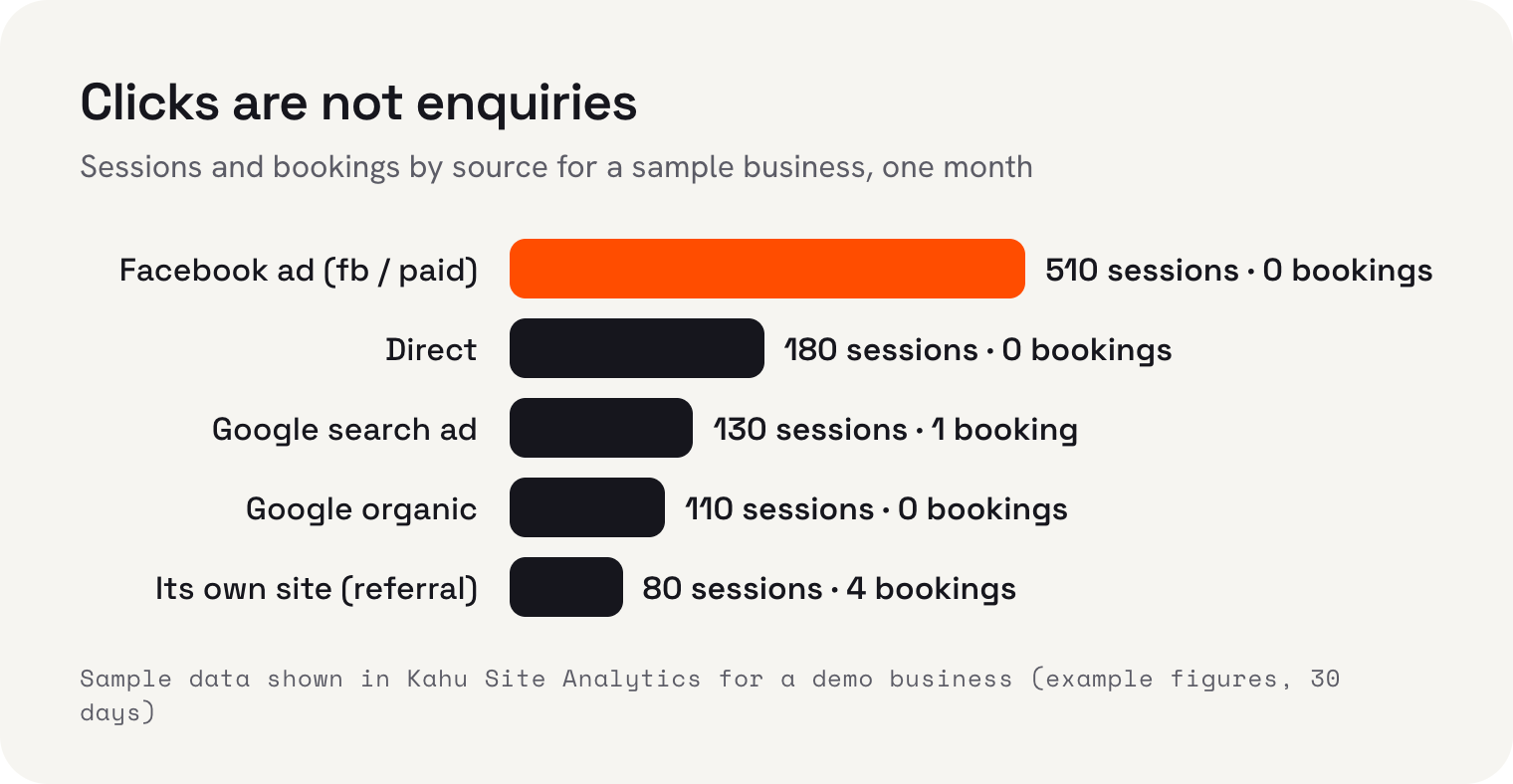
Check the same numbers outside Ads Manager. Your website analytics should show visits and bookings by source. In the example below, from a sample business with sample data, the paid Facebook campaign brought far more sessions than any other source and no bookings, while a handful of visitors from the business's own site booked. That doesn't prove Facebook can't work for this business. It tells the owner where to look: the audience, the offer, or the page those visitors landed on.
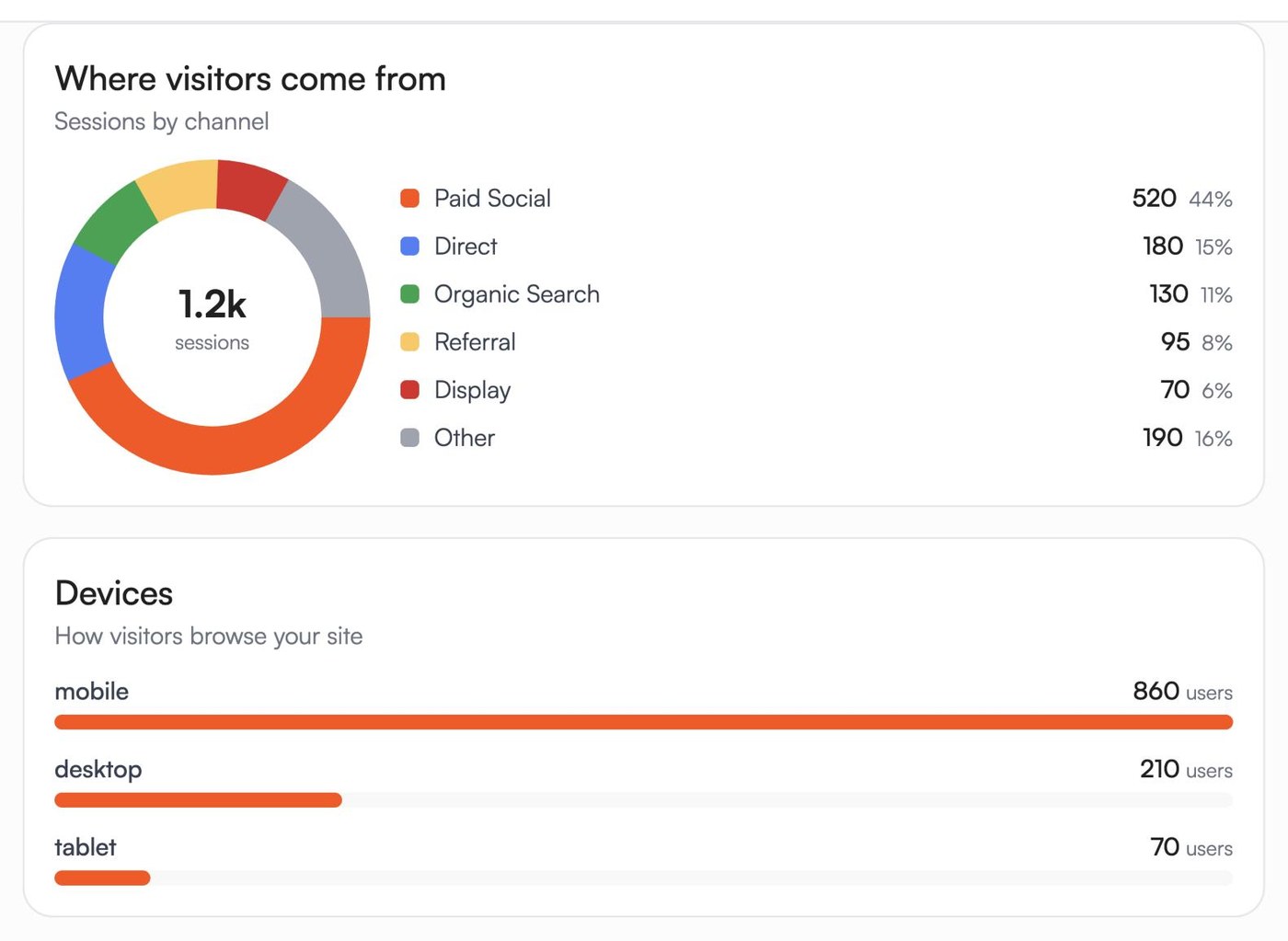
Look at devices too. For most small businesses, the large majority of visitors from social ads arrive on a phone, so judge your ad, your page and your form on a phone, not on the laptop you built them on.
Copy these: five ad copy formulas for Facebook and Instagram
A Meta ad has three bits of text you write: the primary text above the image, a short headline below it, and a button. These five formulas fill all three. Change the square-bracket parts, use your own photo, and read it aloud: if it doesn't sound like you, rewrite it.
- 11. The result and the pricePrimary text: [Result the customer gets] in [area], from [price]. [One detail that builds trust, e.g. same crew every visit / all products included]. Book online in under a minute. Headline: [Service] from [price]. Button: Book now.
- 22. The problem, then the fixPrimary text: [Problem in the customer's words, e.g. Oven you've been avoiding since winter?] We [what you do] so you don't have to. [Time it takes] and [what's included]. Headline: [Fix] in [area]. Button: Get quote.
- 33. The seasonal reminderPrimary text: [Season or date] is [number] weeks away. [What people need done before it]. We've got [number] spots left in [area] for [date range]. Headline: Book before [date]. Button: Book now.
- 44. Before and afterImage: one before and one after photo of a real job, with the customer's permission. Primary text: [Job] in [suburb], done in [time]. [One sentence on what you did]. Want yours to look like this? Headline: [Service] in [area]. Button: Learn more.
- 55. The question for a local audiencePrimary text: [Area] locals, when did you last [task]? Most people should every [interval]. We'll [service] for [price], and you can book a time that suits online. Headline: [Service], [price]. Button: Book now.
To test them fairly, run two formulas at once in the same ad set with the same photo, so only the words differ. Leave them for at least a week, then keep the one with the lower cost per booking, not per click. Swap in a new photo every month or so, since an ad people have seen many times gets less response. And make sure the page the button opens repeats the headline and the price at the top.
Other costs to budget for
- Creative. Photos and short videos of your real work do better than stock images. Budget time, or money, to make a few new ones every month, because the same ad wears out as people see it again.
- Your time or an agency's. A small account needs an hour or two a week: checking results, refreshing ads and replying to comments and messages on the ads themselves.
- Tax. Depending on your country, Meta may add GST or VAT to your ad spend, or you may need to account for it yourself. Check your billing settings and ask your accountant.
- Follow-up. Whatever answers your calls, messages and forms is part of what makes the ads work.
When Facebook ads are the right first spend, and when they aren't
Facebook and Instagram ads suit businesses where seeing the product or the result makes people want it: food, beauty, fitness, home improvements, events, anything visual or local. They also work for things people don't search for because they don't know they exist yet. They're harder for urgent needs, where the customer goes straight to Google, and for high-trust services, where a stranger in a feed needs more convincing than a single ad can give.
If you're choosing between the two, our guide to Google Ads vs Facebook ads walks through the decision, and our guide to Google Ads costs uses the same worked-budget approach for search.
If you only do three things this week
- Work out the most you'd pay for one new customer, and write it next to your current cost per booking (not per click) for each campaign.
- Check that the Meta Pixel is on your website and that a booking or quote request is set up as the result your campaign optimises for.
- Write two new ads from formulas 1 and 2 above with a photo of your own work, and run them side by side in one ad set for a week.
Where Kahu fits
If you'd like help without handing over the keys, here's what our tools do. Kahu Reach drafts Meta ads for your approval, with ad spend paid to Meta from your own ad account and no cut to KahuLogic, and Creative Studio makes posts, reels and story ads from your own photos, which helps with the monthly creative refresh this guide recommends. Website and form enquiries arrive in Kahu CRM as contacts tagged with their source, so you can count enquiries per campaign. Work Kahu drafts waits in your approvals queue until you approve it, and automations run only when you switch them on. Your website, ads and CRM are included from Growth (US$179 a month, or US$149 billed yearly). Starter (US$69) covers social posting, Creative Studio and chat. Starter, Growth and Pro start with a 14-day free trial.
 Where Kahu fits




I'm Muskaan Sharma, User Researcher at KahuLogic, a New Zealand company with a team across Australia, New Zealand and India. If I could change one habit in how owners judge Facebook ads, it would be to stop counting form fills and start counting bookings. Everything else in this guide follows from that.
Frequently asked questions
How much should a small business spend on Facebook ads?
There's no minimum that works for everyone. Work out the most you'd pay for one new customer, then set a daily budget that can bring about 50 of the results you're optimising for each week, so Meta's delivery can learn. Run it steadily for two to three months before judging it on cost per customer.
What is the average cost per click for Facebook ads?
WordStream by LocaliQ's 2026 benchmarks, from US campaigns it manages, put the average cost per click on Facebook traffic campaigns at US$0.60 across industries, about 14% lower than a year earlier. Your own cost depends on your audience, your creative, your offer and the time of year.
What is a good cost per lead on Facebook?
One that leaves a profit once some of those leads become customers. WordStream by LocaliQ's 2026 benchmarks put the average cost per lead at US$27.39 across industries. A cheaper lead from an instant form can still be a more expensive customer if fewer of those leads book, so compare campaigns on cost per customer.
Can Meta spend more than my daily budget?
On a single day, yes. Meta may spend up to 75% more than your daily budget on days with better opportunities, but it won't spend more than seven times your daily budget over a week.
Is boosting a post the same as running a Facebook ad?
Boosting is a quick way to turn a post into an ad, but it gives you fewer choices about the result you want and the people you reach. For anything you plan to measure, set up a campaign in Ads Manager with the result you want, such as leads or bookings.
Why are my Facebook ads getting clicks but no enquiries?
Usually the page or the offer, not the ad. Check that the page matches what the ad promised, loads quickly on a phone and has one obvious way to book or ask. Then check the campaign is optimised for landing page views or leads rather than clicks, and that someone replies to every enquiry quickly.
Sources, checked 3 November 2026
- Meta Business Help Centre: about budgetsfacebook.com
- Meta Business Help Centre: about the learning phasefacebook.com
- Meta Business Help Centre: about ad relevance diagnosticsfacebook.com
- Meta Business Help Centre: about instant form typesfacebook.com
- Meta Business Help Centre: about Meta Pixelfacebook.com
- Meta Business Help Centre: about Conversions APIfacebook.com
- WordStream by LocaliQ: Facebook ads benchmarks 2026 (vendor data)wordstream.com
- Search Engine Land: Facebook ad costs fall as traffic and lead performance improves (2026 benchmarks report)searchengineland.com