How to get your business mentioned in ChatGPT and other AI answers
Geeti Anand·Updated 8 Oct 2026·13 min read

ChatGPT, Perplexity, Copilot and Google's AI features find businesses by searching the web and citing the pages they read. To be mentioned, let their search crawlers into your site (OAI-SearchBot and PerplexityBot in robots.txt), make sure Google can index your pages, keep your Google Business Profile accurate and well reviewed, add LocalBusiness or Organization structured data, and write clear pages that state your services, prices, area and hours as plain facts. There is no way to pay for a mention. Measure it with AI referrals in your analytics and Bing's AI Performance report.
More of your customers are asking an AI assistant before they ask Google. “Quiet café near the station with good coffee.” “Motel near the airport with a kitchenette.” “Physio open Saturday morning.” If your business isn't in the answer, you don't get the visit, and you never find out that someone was looking.
I'm a product manager, so my job is to understand how systems like these actually work and turn that into things people can do. The good news is that getting mentioned isn't a mystery. These assistants mostly search the web, read pages and cite them. You can't buy your way in, but you can make your business easy to find, easy to read and easy to trust.
A disclosure first. We build websites for small businesses at KahuLogic, so the example figures in this guide come from a sample business set up in our own product, and our tools come up once or twice. Every step in the checklist works on any website, whoever built it.
How AI assistants decide which businesses to mention
Start with ChatGPT, because it's the one most people mean. OpenAI said at its October 2026 developer event that its products have “our collective 1.2B weekly users”. When ChatGPT searches the web, OpenAI's help pages say it may rewrite your question into one or more queries and send them to third-party search providers, then read the pages that come back. For local questions it uses an approximate location based on your IP address.
The answer it writes can include citations, and there's a Sources button that lists the pages it used. That's the part that matters for you: a citation is a link to a page, so the page has to exist, be reachable and say something worth quoting. For restaurants, ChatGPT can also hand people to reservation partners, which OpenAI lists as OpenTable worldwide, Resy in the US and Yelp in the US and Canada.
- ChatGPT
 Google AI Overviews and AI Mode
 Google Business Profile
 Perplexity
- Microsoft Bing
- Copilot
The others work in a similar way. Perplexity runs its own crawler, PerplexityBot, to find pages for its answers. Google's AI Overviews and AI Mode only need a page to be indexed in Google's ordinary search. Microsoft reports the pages that Copilot and the AI summaries in Bing cite in Bing Webmaster Tools. So the honest summary is this: being mentioned in AI answers is mostly about being findable and readable in normal search, with a few settings that are specific to AI crawlers.
Step 1: let the right crawlers in
Every website has a small file called robots.txt that tells crawlers what they may visit. If your site builder, host or a plugin has a single “block AI bots” setting, check what it actually blocks. A switch like that can quietly take you out of AI answers altogether if it doesn't distinguish between crawlers that train models and crawlers that find pages to cite.
OpenAI is very clear about this. Its crawler documentation says sites that opt out of OAI-SearchBot won't be shown in ChatGPT search answers. GPTBot is a different crawler, used for training, and you can block it while still allowing OAI-SearchBot. A third one, ChatGPT-User, visits when a person asks ChatGPT to open a page. OpenAI says changes to robots.txt take about 24 hours to be picked up.
| Crawler | Whose | What it's for | What I'd do |
|---|---|---|---|
| OAI-SearchBot | OpenAI | Finding pages to show and cite in ChatGPT search | Allow it, along with its published IP ranges |
| GPTBot | OpenAI | Collecting content to train models | Your choice; blocking it doesn't affect ChatGPT search |
| ChatGPT-User | OpenAI | Visiting a page when a person asks ChatGPT to | Leave it allowed |
| PerplexityBot | Perplexity | Finding pages to show in Perplexity answers; not used for training | Allow it |
| Perplexity-User | Perplexity | Fetching a page a person asked about | Nothing to do; it generally ignores robots.txt |
| Google's AI features | AI Overviews and AI Mode use the normal search index | Make sure Google can crawl and index your pages |
Perplexity says much the same: “we recommend allowing PerplexityBot in your site's robots.txt file.” It also says PerplexityBot isn't used to train models, so allowing it doesn't mean handing your content over for training. If you have a firewall or a hosting company that blocks unfamiliar bots, ask them to let these crawlers through too, because a robots.txt that says yes doesn't help if the server says no.
To check yours, type your web address followed by /robots.txt into a browser. If you see “Disallow: /” under OAI-SearchBot, PerplexityBot or “User-agent: *”, those crawlers are being kept out. If you're not sure what you're looking at, send a screenshot to whoever looks after your site and ask one question: are search crawlers from OpenAI and Perplexity allowed?
Step 2: Google needs nothing special
This is the part that saves you money. Google's documentation for its AI features says a page only needs to be indexed and eligible to show with a snippet in normal search. There's no special AI file to upload and no special markup to add. If someone offers to make your site “AI Overview ready” with a secret file, that's not something Google asks for.
So the Google work is ordinary search work. Open Google Search Console, which is free, and check that your important pages are indexed. Make sure you haven't set any page you care about to “noindex”, and that the page text isn't hidden inside images. If Google can show your page as a normal search result, it can use it in an AI answer too.
Step 3: get your Google Business Profile right
For a local business, your Google Business Profile is often the first thing an assistant finds about you, and it's the source of the address, hours and phone number that many other services copy. Google says local results are ranked on three things: relevance (how well your profile matches the search), distance and prominence (how well known you are).
That makes reviews a practical job, not a vanity metric. Ask happy customers for a review at the moment they're happiest, reply to the ones you get, and keep your hours right, especially on public holidays. Then make sure the name, address and phone number on your profile match your website exactly. An assistant comparing two sources that disagree is less likely to state either with confidence.
Step 4: add structured data so machines read you correctly
Structured data is a small block of code on your page that states facts in a format machines understand: this is a business, this is its name, this is its address. Google documents two types that matter most for a small business. LocalBusiness is for a business with a place customers visit or an area it serves. Organization is for describing the business itself.
- Required for LocalBusiness: name and address
- Recommended for LocalBusiness: geo (map coordinates), openingHoursSpecification (your hours), telephone, url and priceRange
- Organization has no required properties; Google recommends logo, sameAs (links to your other profiles), url, address and contactPoint
Google says Organization markup “helps Google uniquely identify your organization”, which is exactly the problem when there are three businesses with similar names in your town. To be clear, Google also says its AI features don't need special schema. Structured data isn't a ticket into AI answers. It's a way to make sure that when your business is read, your name, address, hours and prices are read correctly.
If your site builder has fields for business details, fill them all in, and ask whether it turns them into structured data for you. If you're on a custom site, ask your developer to add LocalBusiness markup to the home page and contact page, using the same name, address and hours as your Business Profile.
Step 5: write pages an assistant can quote
An assistant cites a page because the page answers the question. Most small business websites don't, because they're written to sound nice rather than to state facts. “We offer a range of quality services to suit every need” can't be quoted. “Gel manicures from $45, open until 8 pm on Thursdays, five minutes' walk from the central station” can.
Those numbers are from Pew Research Center, which tracked 68,879 Google searches by 900 US adults. They tell you two things. Summaries are short and usually draw on several sources, so you're competing to be one of a handful of names in about 67 words. And very few people click the links inside a summary, so the mention itself, your name in the answer, is often the win, even when nobody clicks.
So write for the mention. Give each service its own page with a plain heading. Put prices or a “from” price on it. Say where you work, by suburb, town or region. List your hours. Answer the five questions customers ask you most often, on the page, in their words. None of this is new advice. It's what good local pages have always needed, and it's exactly what an assistant looks for when it writes a short answer.
What you can't control
There's no paid placement. None of the official documentation from OpenAI, Google, Microsoft or Perplexity linked in this guide describes any way to pay to be mentioned in an answer. If someone sells you a guaranteed spot in ChatGPT, ask them to show you where OpenAI offers one.
You also can't control which question a customer asks, how the assistant phrases it as a search, or which competitor happens to have a better page that day. Answers change from one person to the next, and with location. That's why I'd treat AI mentions the way you treat word of mouth: do the things that earn it, and measure the visits it sends, rather than trying to check every answer by hand.
How to measure AI mentions and visits
The simplest measure is the visits AI assistants send you. When someone clicks a cited link in ChatGPT, the visit usually arrives from chatgpt.com, and your analytics can show it as a separate source. Here's what that looks like with example figures. Take a sample business in Kahu, a small business that takes bookings online with its website on Kahu Sites. These are its sample numbers in Kahu's Site Analytics over 30 days.
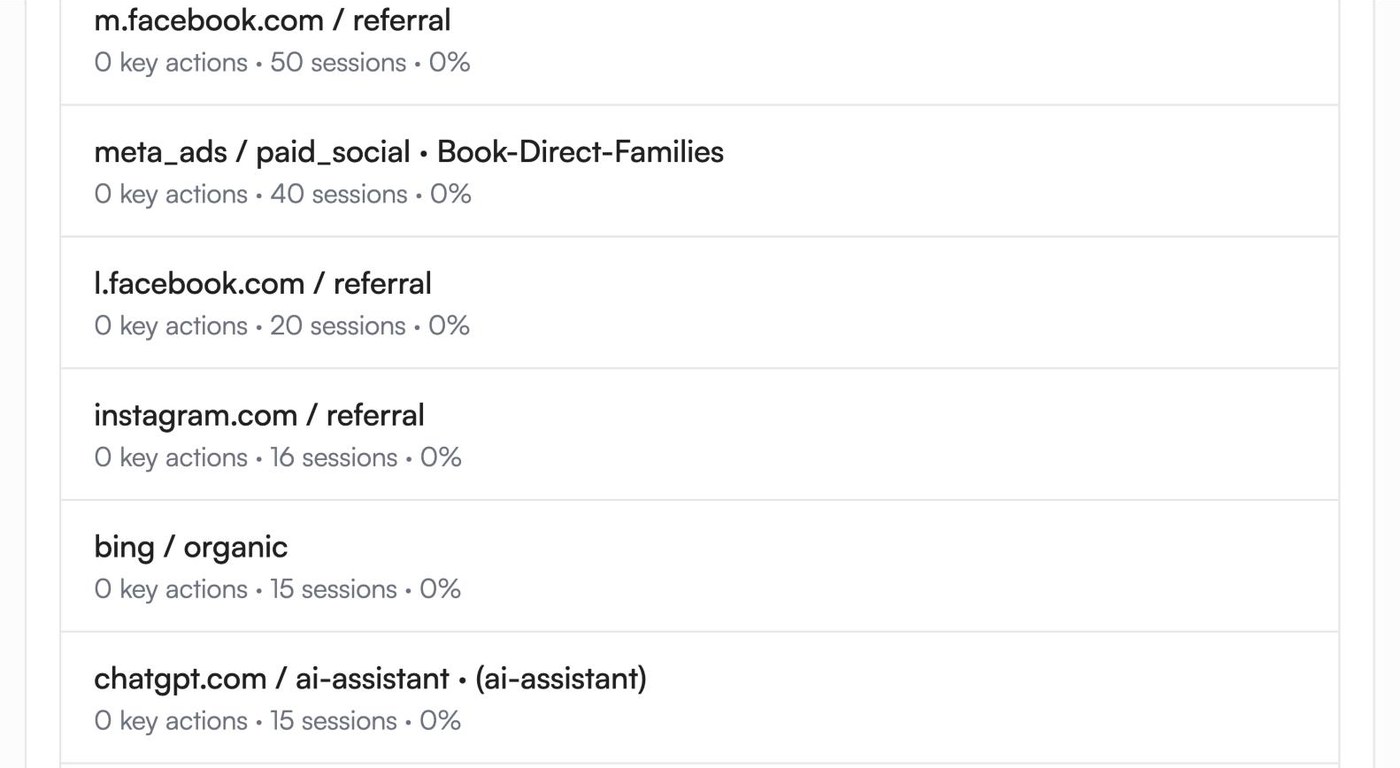
In the sample, ChatGPT sends 15 sessions tagged as an AI assistant, plus 4 more from chatgpt.com that are counted as ordinary referrals. Gemini sends 2. Organic search sends 130 in the same period. So AI assistants are a small source in this example, about a sixth of what search sends, but each of those visits is a person who asked a question and was pointed to the business by name.
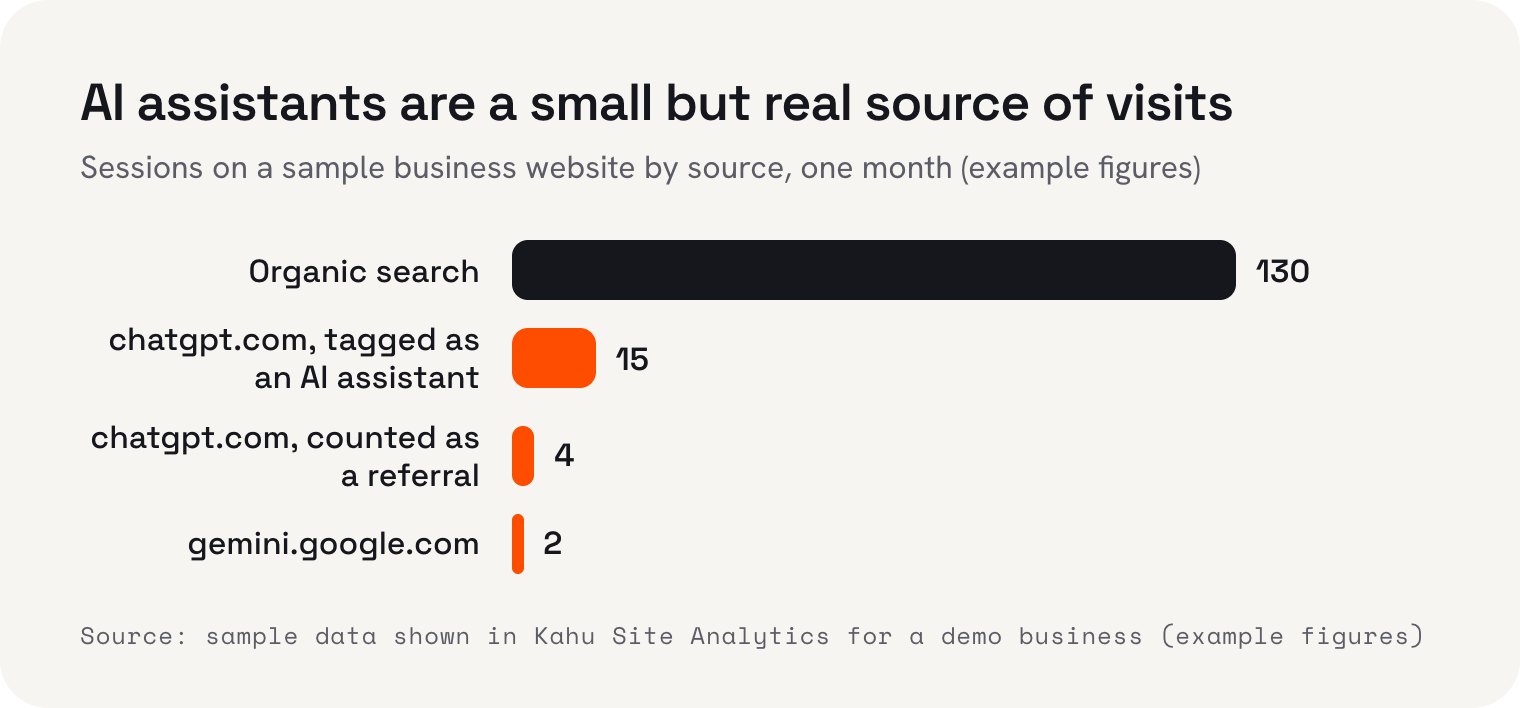
Notice that the same assistant showed up in two places. That's common: depending on how a visit arrives, an analytics tool may label chatgpt.com as an AI assistant or as a plain referral. When you check your own numbers, look for chatgpt.com, gemini.google.com and any other AI assistant in your referral list, and add them up.
The second measure is citations, which count mentions even when nobody clicks. Microsoft added an AI Performance report to Bing Webmaster Tools in February 2026, as a public preview. It shows your total citations, how many of your pages were cited each day, a sample of the grounding queries that led to them, and citations page by page. It covers Copilot, AI summaries in Bing and some partner services. It doesn't measure clicks, so read it alongside your analytics.
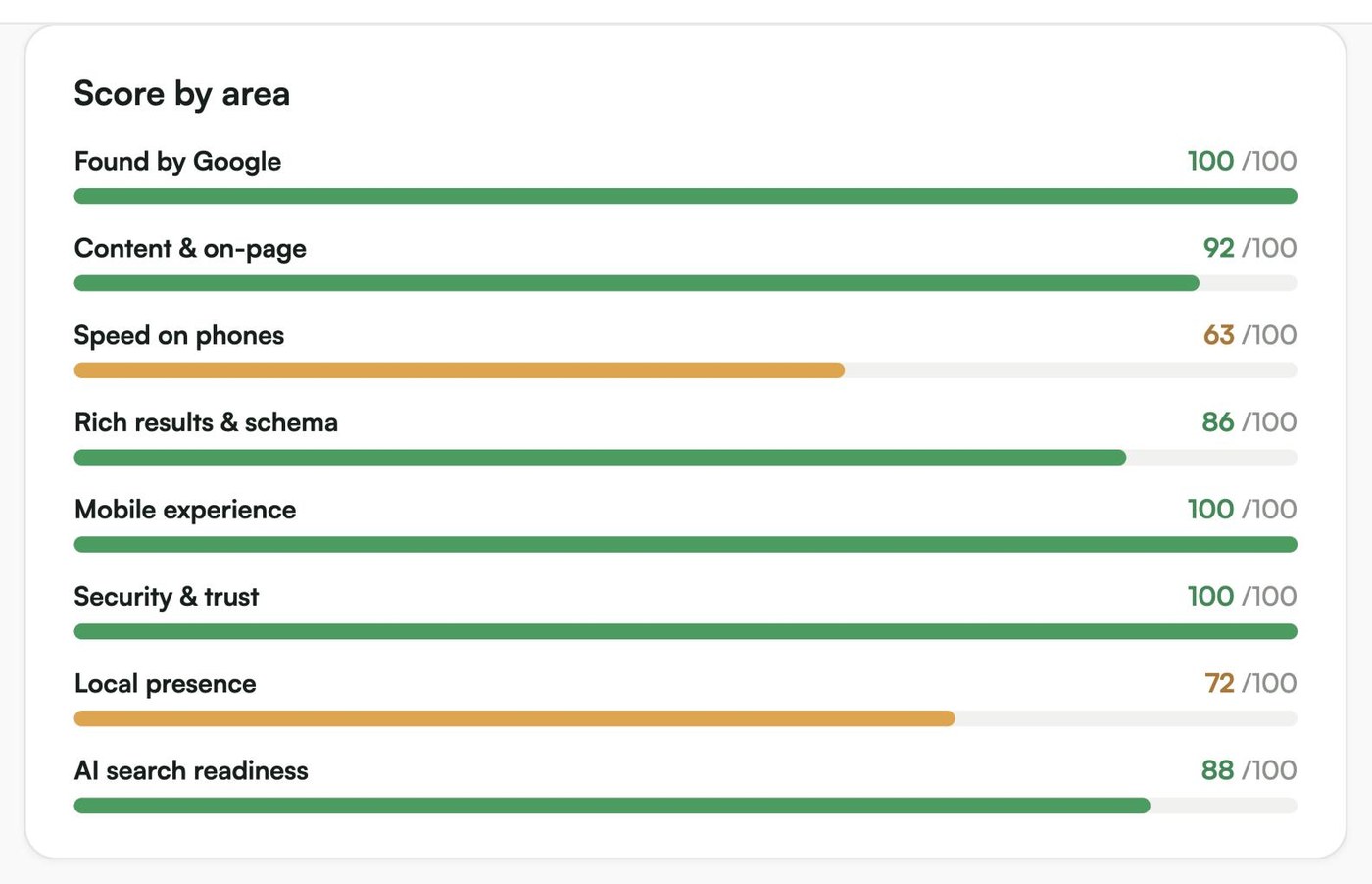
If your site runs on Kahu, the Search Visibility page gives an AI search readiness score next to the other areas. In the sample account it's 88 out of 100. A score like this is a checklist of the things above, not a promise of mentions, but it tells you where the gaps are without reading code.
 Where Kahu fits


Your checklist for this week
Here's the order I'd do it in. Each step takes less than an hour for most small businesses, and the first two are the ones most often missed.
- 1Check robots.txtOpen yoursite/robots.txt. Make sure OAI-SearchBot and PerplexityBot aren't blocked, and ask your host whether a firewall blocks them.
- 2Check Google can index youIn Google Search Console, confirm your home page and each service page are indexed and not set to noindex.
- 3Fix your Business ProfileMatch your name, address, phone and hours to your website exactly, then ask three happy customers for a review.
- 4Add structured dataAdd LocalBusiness markup with name, address, hours, phone, url and price range, and keep it matching your Business Profile.
- 5Rewrite one page as factsPick your most important service page. Add prices, area, hours and the five questions customers ask most.
- 6Start measuringFind AI assistants in your analytics referrals, and set up Bing Webmaster Tools to see the AI Performance report.
Then leave it a month and look again. Crawlers need time to revisit your pages, and OpenAI alone says robots.txt changes take about a day to register. If AI visits and citations creep up, keep going with the next service page. If nothing moves, go back to step one and check that nothing is still blocking the crawlers.
I'm Geeti Anand, Product Manager at KahuLogic, a New Zealand company with a team across Australia, New Zealand and India. We build and look after websites and marketing for small businesses, and this is how I'd get a business into AI answers whether or not you ever use us.
Frequently asked questions
Can I pay to have my business recommended by ChatGPT?
No. None of the official documentation from OpenAI, Google, Microsoft or Perplexity describes a way to pay for a mention in an AI answer. Mentions come from the pages these assistants find and cite, so the work is making your site crawlable, accurate and clear.
How does ChatGPT find local businesses?
When ChatGPT searches the web, OpenAI says it may rewrite the question into queries for third-party search providers and uses an approximate location from the person's IP address for local results. It reads the pages that come back and can cite them, with a Sources button listing the pages used.
Should I block GPTBot?
That's your choice. OpenAI says GPTBot collects content for training, while OAI-SearchBot finds pages for ChatGPT search. You can block GPTBot and still allow OAI-SearchBot, and OpenAI says sites that block OAI-SearchBot won't be shown in ChatGPT search answers.
Do I need special files or schema for Google's AI Overviews?
No. Google says there are no additional technical requirements for AI Overviews and AI Mode. A page needs to be indexed and eligible to show with a snippet in normal search. Structured data still helps Google read your business details correctly.
How can I tell if ChatGPT is sending me customers?
Look in your analytics for visits from chatgpt.com, gemini.google.com and other AI assistants. Some tools label these as AI assistants and some as referrals, so check both. For citations without clicks, Bing Webmaster Tools has an AI Performance report covering Copilot and Bing's AI summaries.
How long does it take to start appearing in AI answers?
There's no fixed time. OpenAI says robots.txt changes take about 24 hours to register, but crawlers then need to revisit your pages and assistants need a reason to cite them. Make the changes, then check your analytics and Bing's report after about a month.
Sources and further reading
- OpenAI: overview of OpenAI crawlersdevelopers.openai.com
- OpenAI Help Center: ChatGPT searchhelp.openai.com
- OpenAI: DevDay 2026 recap (October 2026)openai.com
- Google Search Central: AI features and your websitedevelopers.google.com
- Bing Webmaster Blog: Introducing AI Performance in Bing Webmaster Tools (10 February 2026)blogs.bing.com
- Perplexity: Perplexity crawlersdocs.perplexity.ai
- Pew Research Center: Google users are less likely to click on links when an AI summary appears (22 July 2025)pewresearch.org
- Google Business Profile Help: how to improve your local rankingsupport.google.com
- Google Search Central: LocalBusiness structured datadevelopers.google.com
- Google Search Central: Organization structured datadevelopers.google.com