What is digital marketing? A plain guide for small business owners
Muskaan Sharma·Updated 3 Nov 2026·13 min read

Digital marketing is everything you do online to get the right people to notice you, trust you and get in touch: your website, search engines, your Google Business Profile, social media, email and SMS, and paid ads. For a small business, start with the free, high-intent basics: a complete Google listing, a website that shows what you do and what it costs, and fast replies to enquiries. Add one social channel and occasional emails to past customers, then test ads, judging every channel by enquiries rather than clicks.
“You need to do more digital marketing” is advice almost every small business owner has heard, usually from someone selling it. It sounds like one big job. In practice it's a handful of small, ordinary ones: keeping your Google listing accurate, having a website that answers the obvious questions, posting now and then, emailing past customers, and sometimes paying for ads.
This guide explains what digital marketing is, how the parts connect, and the order I'd do things in if I ran a florist, a salon or a plumbing business with limited time and a modest budget.
I'm a user researcher at KahuLogic, where we build websites and marketing tools for small businesses. I'll mention our own tool once, near the end; everything else works whichever tools you use.
What is digital marketing, in plain words?
Digital marketing is everything you do online to get the right people to notice you, trust you and get in touch. Your Google listing, your website, your Instagram account, the email you send past customers and any ads you pay for online are all digital marketing. Printed flyers, signs, radio and the local paper are traditional marketing.
The reason it matters is simply where people are. DataReportal's Digital 2026 report puts internet users worldwide at more than six billion, and in New Zealand it counts 4.24 million social media user identities, equal to about 80.6% of the population. When someone needs a plumber, a birthday cake or a physio, most of them start on a phone.
Reviews are part of it too. BrightLocal's 2026 survey of US consumers, which is vendor data, found 97% read reviews for local businesses. Digital marketing isn't a replacement for being good at what you do. It's the way people find out that you are.
What are the main types of digital marketing?
There are six channels most small businesses use. You don't need all of them, and the table shows what each one is good at so you can pick.
| Channel | What it does | Cost | Best for |
|---|---|---|---|
| Your website | Explains what you do, shows prices and takes enquiries | Hosting and a domain, or a platform fee | Every business: it's where other channels send people |
| Search (SEO) | Shows your pages when people search for what you offer | Mostly your time | Steady visits that build over months |
| Google Business Profile | Puts you on Google Maps and local results with hours, photos and reviews | Free | Any business with local customers |
| Social media | Keeps you visible to people who already follow you | Free to post, your time to make content | Visual businesses and repeat customers |
| Email and SMS | Brings past customers back with news, offers and reminders | Often free at small sizes, then a monthly fee | Rebookings and repeat sales |
| Paid ads | Buys attention on Google, Facebook, Instagram and elsewhere | Whatever you set as a budget, paid to the platform | Fast results when you have a clear offer |
People sometimes group these as owned (your website, your email list), earned (search rankings, reviews, word of mouth online) and paid (ads). It's a useful way to think about risk. You control what you own. Earned channels are free but slow. Paid channels are fast but stop the day you stop paying.
How do the pieces fit together?
Digital marketing works as a chain, not a menu. Each channel should move someone one step closer to becoming a customer, and a weak link anywhere wastes the effort spent everywhere else.
Ads and social posts bring people to your website or listing. The website turns some of them into enquiries. A fast, friendly reply turns enquiries into customers. Email and SMS bring customers back. Ask a new customer how they found you and you can see which link in the chain is working.
The weak link I'd look for first is almost never the one owners expect. People tend to assume they need more visitors. Often they have visitors already, but the website hides the price, the phone number is hard to find on a phone, or enquiries sit unanswered for two days. Fixing a leak is cheaper than pouring more in.
Digital vs traditional marketing: which is better?
Neither is better in general. Digital marketing is easier to measure and adjust, and you can start small. Traditional marketing can still work well locally, such as a sign on the van, a flyer in the right letterboxes, or a sponsored local sports team. The two work best together: a flyer that sends people to a page with your prices, or a van with a web address people can remember.
What digital does better is tell you what worked. A Google Ads campaign shows the searches that led to clicks. Google Analytics shows which pages people visited before they enquired. A flyer can do some of that too, if you give it its own phone number or a short web address and count what comes in.
Where should a small business start?
Start with the free, high-intent things, then add paid channels once the basics convert. This is the order I'd use, and why.
- 1Claim your Google Business ProfileGoogle says creating a profile is free. Verify it, add your hours, services, service area and real photos. For a local business, it's often the first thing a customer sees.
- 2Fix your website's first screenWithin a few seconds on a phone, it should say what you do, where, roughly what it costs, and give one obvious way to get in touch.
- 3Make replying fastDecide who answers enquiries and how quickly. A same-day reply is a marketing channel in its own right.
- 4Pick one social channelChoose the one your customers actually use and post at a pace you can keep for a year, not a week.
- 5Email past customersWith their permission, send a short, useful message every month or two: a seasonal reminder, a new service, a quiet-week offer.
- 6Then test adsOnce the rest converts, run a small, focused campaign with a clear offer, and judge it on enquiries, not clicks.
If you only have two hours a week, I'd spend them on the first three. A complete listing, a clear website and fast replies will usually do more than a busy Instagram account attached to a website that hides the phone number.
A worked example: a florist's first three months
Here's a worked example. The business and every number in it are made up, so swap in your own. Picture a florist with a small shop, a basic website, an Instagram account she posts to now and then, and US$300 a month she's willing to spend on marketing.
Month one costs her nothing but time. She verifies her Google Business Profile, adds her opening hours, delivery area and twenty photos of real arrangements. She adds a price range and a delivery cut-off time to her website's home page and puts the order button at the top. She asks the last thirty customers who bought online whether they'd like an occasional email, and twelve say yes.
Month two, she spends US$150 on a Google Search campaign for “flower delivery” and a few close variations in her delivery area, and keeps US$150 back. She notices most clicks come on Thursday and Friday afternoons, before weekend events, and that most visitors are on phones.
Month three, she sends her small email list a Mother's Day reminder two weeks out, with a link to order. In this made-up case, the email brings six orders from twelve people, the ads bring nine orders from about 140 clicks, and her Google listing brings a handful of phone calls she now asks about. She moves the rest of her budget to the week before the next big date, because that's when people search.
Now the sums, still made up. Say her average online order is US$80. The ads brought 9 orders × US$80 = US$720 of sales from US$150 of spend, so each ad order cost her about US$16.70 (US$150 ÷ 9). The email brought 6 orders × US$80 = US$480 for no spend at all. Over the three months she spent US$150 of her US$900 budget and kept the rest for the next busy week. None of those steps is clever, and she can see exactly which part earned its keep.
How do you measure digital marketing?
Count enquiries and customers, not likes and visits. Likes and visits are useful clues, but they don't pay rent. The simplest measuring system has three parts.
- Ask every new customer how they found you, and write it down. A tick box on your enquiry form or a note in your booking system is enough.
- Set up Google Analytics and mark your important actions, like a form submission or a booking, as key events. Google's help pages explain how, and a standard property lets you mark up to 30 events as key events.
- Once a month, write down what you spent on each channel and how many customers it brought. Divide one by the other.
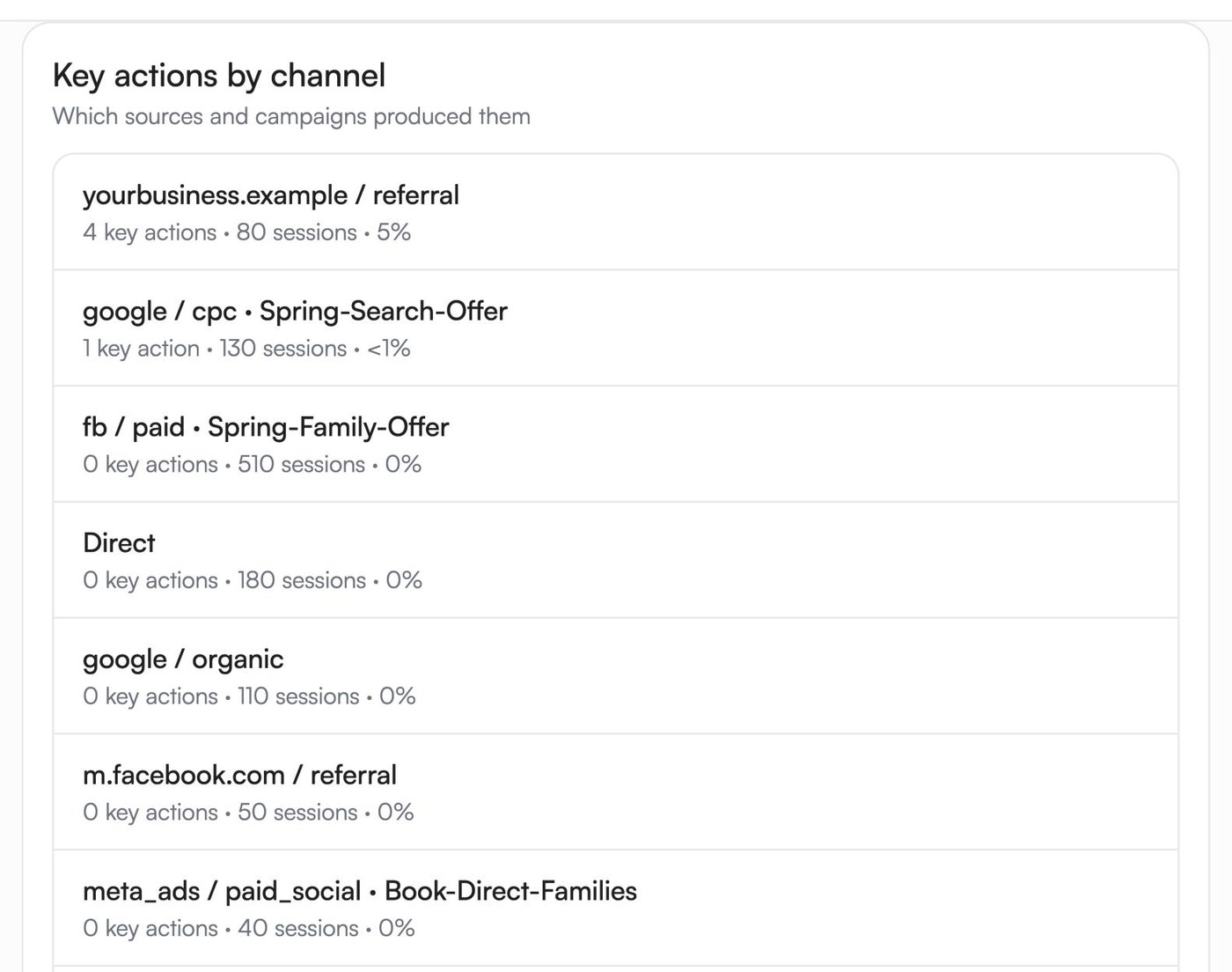
Whatever tool you use, this is the view worth finding. In the sample above, the paid Facebook campaign sent the most visits and none of the key actions. That doesn't prove the campaign is useless, but it's exactly the question you'd want to ask before spending more on it.
Copy this: a one-page marketing plan
Most small businesses don't need a marketing strategy document. They need one page they can stick on the wall and check every month. Copy these six headings into a document, fill in the square brackets, and keep it to one page. If it won't fit, you're trying to do too much.
- 11. Who we're forWe help [who, e.g. busy parents within 20 minutes of town] who need [what, e.g. same-day flowers for birthdays and sympathy]. They usually find us by [how, e.g. searching on their phone the day before].
- 22. What we want this quarter[One number, e.g. 40 online orders a month, up from 25] by [date]. Everything below should help with this number or it waits.
- 33. Our offer in one sentence[What you do], [where], from [price], [what makes it easy, e.g. order by 1pm for same-day delivery].
- 44. Channels, in orderMust do: [Google Business Profile, website first screen, replies within (2) hours]. Next: [one social channel, e.g. Instagram, twice a week]. Then: [email past customers monthly; a US$(150) Google Search test before (date)]. Not this quarter: [everything else, e.g. TikTok, print ads].
- 55. Weekly routine[Monday, 30 min]: post and check the Google listing. [Daily]: reply to every enquiry by [time]. [Friday, 15 min]: write down this week's enquiries by source. [First Monday of the month]: send the email.
- 66. Budget and what we countMonthly budget: [amount], split [e.g. US$0 free channels, US$150 ads, US$30 email tool]. We count enquiries and customers by source, not likes. We stop or change any paid channel that costs more than [US$ amount] per customer after [6] weeks.
And here's the monthly tracking table that goes with it. The example row is made up.
| Channel | Spent this month | Enquiries | Customers | Cost per customer |
|---|---|---|---|---|
| Google Search ads (made up) | US$150 | 14 | 9 | US$16.70 |
| Email to past customers (made up) | US$0 | 6 | 6 | US$0 |
| Google Business Profile | [amount] | [count] | [count] | [spend ÷ customers] |
| [amount] | [count] | [count] | [spend ÷ customers] |
Section 6 is the one owners skip, and it's the one that saves money. Deciding in advance what a customer is worth paying for stops you renewing an ad campaign because it "feels busy".
Rules to know before you email or text customers
Email and SMS marketing come with laws in both Australia and New Zealand, and they're simple to follow if you know them. In Australia, the Spam Act, enforced by the ACMA, requires consent, clear identification of who's sending, and a working unsubscribe in every commercial message. The Australian Government's business.gov.au guidance sets out the same three rules for email and text.
In New Zealand, the Unsolicited Electronic Messages Act 2007 is enforced by the Department of Internal Affairs, which says commercial electronic messages must go only to people who have consented and must include a working unsubscribe. In practice, that means: ask before you add someone to a list, say who you are in every message, make unsubscribing easy, and honour it quickly. Don't buy lists.
Common mistakes I'd avoid
- Being on every platform badly instead of two platforms well.
- Paying for ads before the website and replies are ready to turn clicks into customers.
- Judging a channel on likes, followers or clicks instead of enquiries.
- Letting the Google listing go stale: wrong hours on a public holiday cost real customers.
- Hiding prices completely. A range or a “from” price helps people decide to contact you.
- Copying what a big brand does. A local bakery doesn't need a brand awareness campaign; it needs people nearby to know it's open on Sundays.
How long does digital marketing take to work?
It depends on the channel. Paid ads can bring enquiries within days of starting, because you're buying attention directly. A Google Business Profile can help within weeks once it's verified and complete. Search rankings and social media usually build over months, and they keep building for as long as you keep at them.
My advice is to plan for a year, not a month. Use paid ads for the quick wins while the slower, free channels grow underneath them. Over time, the free channels should carry more of the load, and the ads become something you turn up for busy seasons rather than something you depend on.
If you only do three things this week
- Check your Google Business Profile: hours for the next public holiday, service area, and five recent photos.
- Open your website on your phone and make sure the first screen says what you do, where, a price range and how to get in touch.
- Fill in sections 1 to 4 of the one-page plan above, and add "How did you find us?" to your enquiry form.
Where Kahu fits
If you'd like help without handing over the keys, here's what our tools do. Kahu covers the chain in this guide: Kahu Sites is your website on your own domain, hosted and updated by Kahu; Kahu Reach drafts Google and Meta ads and email campaigns, plus SMS campaigns in Australia (New Zealand is in progress and launching soon), with ad spend paid to Google and Meta from your own ad accounts and no cut to KahuLogic; and website and form enquiries arrive in Kahu CRM tagged with their source, which fills in the "Enquiries" column of the table above for those channels. Work Kahu drafts waits in your approvals queue until you approve it, and automations run only when you switch them on. Your website, ads and CRM are included from Growth (US$179 a month, or US$149 billed yearly). Starter (US$69) covers social posting, Creative Studio and chat. Starter, Growth and Pro start with a 14-day free trial.
 Where Kahu fits




I'm Muskaan Sharma, User Researcher at KahuLogic, a New Zealand company with a team across Australia, New Zealand and India. My view is that digital marketing is mostly about being easy to find and easy to say yes to, and the businesses that get those two right rarely need anything fancier.
Frequently asked questions
What is digital marketing in simple words?
Digital marketing is any marketing that reaches people online: your website, search engines, your Google Business Profile, social media, email, SMS and online ads. For a small business the aim is to be easy to find, give people a reason to choose you, and make it easy to get in touch.
What are the main types of digital marketing?
The main types are your website, search engine optimisation (SEO), local listings such as Google Business Profile, social media, email and SMS marketing, and paid ads on platforms like Google, Facebook and Instagram. Most small businesses do well with three or four of these done consistently.
How much should a small business spend on digital marketing?
Start with the free channels, which cost time rather than money. Then add a small ad budget you can afford to learn from, and increase it only for the channels that bring real enquiries. Judge spend by cost per customer, not cost per click.
How long does digital marketing take to work?
Paid ads can bring enquiries within days. A complete Google Business Profile can help within weeks. Search rankings and social media usually take months to build, but keep paying off as long as you maintain them.
Can I do digital marketing myself?
Yes. The basics, a complete Google listing, a clear website, fast replies, regular posts and occasional emails, need time and consistency more than expertise. Many owners bring in help later for ads or website changes.
Do I need to be on every social media platform?
No. Pick the one or two platforms your customers actually use and post at a pace you can keep. Doing two channels well beats doing six badly.
Sources, checked 3 November 2026
- DataReportal: Digital 2026 Global Overview Reportdatareportal.com
- DataReportal: Digital 2026: New Zealanddatareportal.com
- BrightLocal: Local Consumer Review Survey 2026 (vendor survey of 1,002 US adults)brightlocal.com
- Google Business Profile Help: add or claim your Business Profilesupport.google.com
- Google Business Profile: get listed on Googlebusiness.google.com
- Google Analytics Help: mark events as key eventssupport.google.com
- business.gov.au: promoting your business by email or text messagesbusiness.gov.au
- NZ Department of Internal Affairs: New Zealand spam lawdia.govt.nz